|
|
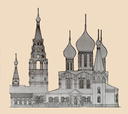
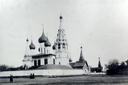
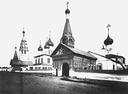
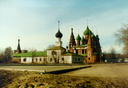
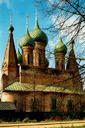






The Church of St. Nicholas-on-the-Waters Yaroslavl, Russia |
History |
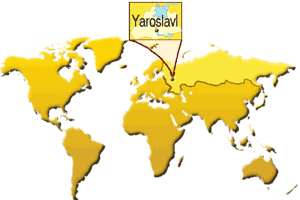
Our parish church of St. Nicholas on the Waters (Nikola Mokry as it is known in Russian) is situated close to the centre of the modern city of Yaroslavl, situated in the centre of the Golden Ring of European Russia. |
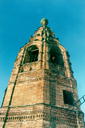
At the beginning of 1930 Moscow ordered the church iconostasis to be disassembled. Most of the icons were sold abroad or destroyed. Only the carved "Tsar places" were undamaged and these were moved to the Church of Elijah the Prophet. One final twist in the tail: In 1979 restoration of the frescoes and the repair of the church buildings was started, in readiness for its return to us, which was in 1991, but it was during this initial work that a macabre reminder of the church's violent history was uncovered. Whilst inspecting the top of the bell-tower for damage, the workers discovered the remains of a brave young White Guard Officer still at his post. He had been killed during the Red Guard's storming of the church, but for over 60 years his body had remained at his station, still in his uniform, with his machinegun by his side, on watch over our church until the dark times had passed. His body was laid to rest shortly afterwards, his uniform and arms are now displayed in Yaroslavl's main museum, and Nikola Mokry is once again the focal point for worship in our community. |
In the beginning: Our history starts in the 1640's when the wooden churches of St. Nicholas the Miracle Worker and that of the miraculous icon of Virgin of Tikhvin were built on the site that had previously been the centre of pagan worship in the original settlement upon which Yaroslavl was later founded, complete with its own henge (like Stonehenge in England), at the centre of which was the sacred "blue stone". It is known that the pagans worshipped this stone, but not documented that it was the actual sacrificialstone, as was the case in other areas of Europe, but if it was one can only imagine the horrors it may have witnessed over the many centuries before our church was built. |
Construction in brick: |
In the late 1600's Tsar Alexey Mikhailovich gave the area to the municipal administration of Yaroslavl, and in 1665 the Nikola Mokry church in the form we now know it was built, followed some 30 years by the small winter church of Virgin of Tikhvin. The altar from the dismantled wooden church was installed as well as a clock and the bells were hung in the belfry. |
Because of our extreme winters it is normal in Russia to have two church buildings, so in our complex we have both the Nicholas Mokry church itself, which is a summer church as it has no heating, and the smaller winter church of Virgin of Tikhvin, which is heated. At the end of 1690's the main porches, or galleries, were richly decorated with coloured ceramic tiles and the church walls were covered with frescos, both inside and out. At the end of the 17th century such was Nikola Mokry's standing in the community that it became the military chapel for Yaroslavl's local garrison, which at that time was composed of troops loyal to the Tsar and the Royal Family (the White Guard). The October Revolution: |
Divine service in the churches continued until the October Revolution of 1917, when Red Guards (Communists) stormed the church. The church was heavily defended by the garrison's company, but they were eventually over-run. The bombardment caused heavy damage to the church buildings and especially the bell-tower. Such was the Red Guard's hatred of the building that it was used as warehouses for books on the doctrines of Lenin and Marx, and later a chemical factory was established inside. |
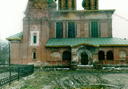
To draw a final curtain over any pagan influences that may have still remained within in the community, the church's builders buried the "blue stone" directly under the church's main entrance, where it remains to this day, so that worshipers show their contempt for the false pagan gods by stepping on it as they enter the church. |
Copywrite © Nikola Mokry 2007 |
Site designed and built by Appropriate Solutions design@appropriate-solutions.co.uk |